Quick Summary
- CGT applies: Cryptocurrency is treated like shares by the ATO, so Capital Gains Tax applies to profits.
- CGT events: Selling, swapping, gifting, or using crypto to buy goods triggers a CGT event.
- CGT discount: Hold crypto for over a year to qualify for a 50% CGT discount, reducing your taxable gain.
- Record keeping: Track dates, amounts, and types of transactions - tools like Koinly can automate this.
- Reporting: Declare crypto gains/losses in the capital gains section of your tax return.
What Is Cryptocurrency Tax?
If you've been buying, selling, or trading cryptocurrency in Australia, you need to know about the tax implications. The Australian Taxation Office (ATO) sees crypto like shares, so you will likely need to pay Capital Gains Tax (CGT) on your profits.
When you swap, sell, gift or use crypto to buy stuff that's called a "CGT event." You need to figure out if you made a profit or loss on each of these. Your profit or loss is the difference between what you paid for the crypto and what you got when you got rid of it. The ATO has more info on this here: https://www.ato.gov.au/individuals-and-families/investments-and-assets/crypto-asset-investments
CGT Discounts: If you held your crypto for over a year, you might get a CGT discount. This means you only pay tax on half your profit. For example, if you made a $10,000 profit after holding for more than a year, you'd only report $5,000 as a capital gain. To get this discount, you need to keep good records of when you bought and sold your crypto. Check out the ATO website for more on the CGT discount: https://www.ato.gov.au/individuals-and-families/investments-and-assets/capital-gains-tax/cgt-discount
Tools: Keeping track of all your crypto trades is a real pain. Koinly can help. I've personally used Koinly, and it made things much easier. I just connected it to my crypto exchange and wallet, and it automatically pulled in all my transactions. It worked out my profits and losses, including the CGT discount, and gave me a tax report I could give to my accountant. You can find Koinly here: https://koinly.io/.
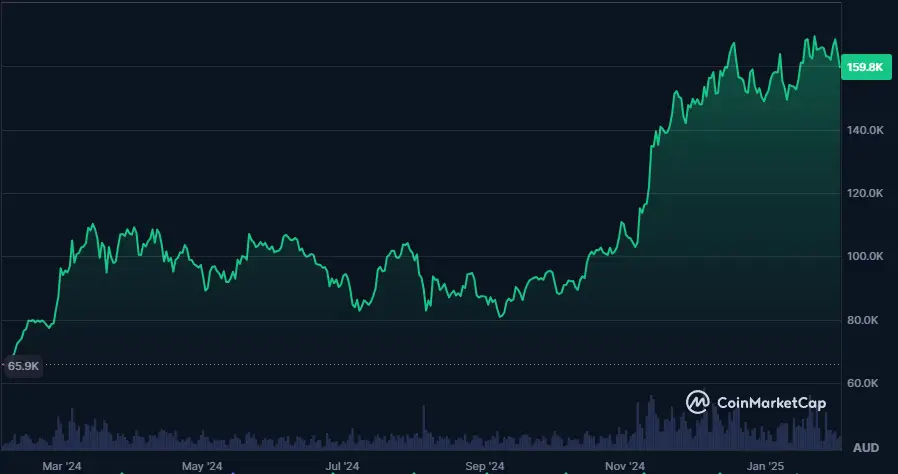
Bitcoin to AUD Price last 12 months. Source: https://coinmarketcap.com/currencies/bitcoin/
Remember that everyone's experience may be different and there are other ways to report your crypto, such as through an accountant, or directly to the ATO. For most people, this involves completing the capital gains or losses section on your tax return. For more information on how to lodge your tax return, see here: https://www.ato.gov.au/individuals-and-families/your-tax-return.
If you don't report your crypto profits correctly, you could get in trouble with the ATO. They can track crypto transactions on exchanges, so it's best to be upfront and do things by the book. The ATO has some tips on keeping records for your crypto here: https://www.ato.gov.au/individuals-and-families/investments-and-assets/crypto-asset-investments/keeping-crypto-records.
While crypto can be exciting, it's important to understand the tax rules. This article gives you a basic overview, but there's more to learn and seek accounting or finance expert to learn more.
Disclaimer: This article is for informational purposes only and isn't financial or tax advice. Tax rules can be tricky and change often. It's always best to talk to a qualified tax professional or accountant who understands your specific situation. They can give you the most accurate and up-to-date advice. You can also check the official Australian Taxation Office (ATO) website for the latest information. Using crypto tax software like Koinly can be helpful, but it's still your responsibility to make sure your tax reporting is correct.
Key Takeaways
- Cryptocurrency is subject to Capital Gains Tax in Australia.
- Hold crypto for over 12 months to qualify for the 50% CGT discount.
- Every sale, swap, gift, or purchase using crypto is a CGT event.
- Keep detailed records of all transactions for tax reporting.
- Consider using tools like Koinly to automate tax calculations.